Laurent-Perrier Cuvée Rosé Brut Champagne


Introduction
When you think of rosé Champagne that marries elegance with bold colour and a rich fruit character, one of the first names that comes to mind is the Cuvée Rosé Brut from Laurent-Perrier. This Champagne is something of a benchmark in the category: it is distinctive, well-crafted, and rooted in the history and innovation of a major Champagne house. In this article we will dive deeply into its provenance and production, its tasting profile, how to serve and pair it, its market position, and—importantly—address the “People also ask” questions that many buyers and enthusiasts search for. At the end we’ll give a considered conclusion: whether it’s a smart buy, when and where, and how it fits into special occasions or everyday enjoyment.
1. The House & Heritage
Origins and Innovation
Laurent-Perrier was founded in 1812 in Tours-sur-Marne, Champagne, France. Over the decades the house has grown in reputation, innovation and quality.—Their approach emphasises freshness, elegance and finesse rather than heaviness. For the Cuvée Rosé, Laurent-Perrier pioneered in 1968 the use of maceration rosé (sometimes called the saignée method) of Pinot Noir grapes—an unusual choice at the time for rosé Champagne. (Laurent-Perrier)
In fact, on their official site they note:
“Since 1968, Laurent-Perrier has developed the mastery of a very particular and rare know-how in Champagne: maceration. This process makes it possible to obtain the richest and most subtle expression of Pinot Noir.” (Laurent-Perrier)
That innovation is critical to understanding the style of Cuvée Rosé.
Philosophy & Style of the House
Laurent-Perrier’s broader philosophy is summarised on their website and in tasting notes: they strive for integrity of fruit, refined structure, and a style that can present both immediately and with some ageing. The Cuvée Rosé is emblematic of the house’s willingness to break conventions (rosé Champagnes were not widely fashionable in the late 1960s) and craft a premium expression of Pinot Noir. (Laurent-Perrier)
2. The Cuvée: Technical Profile & Production
Grape Variety & Sourcing
- The blend for Cuvée Rosé is 100% Pinot Noir. (Laurent-Perrier)
- The grapes are sourced from about 10 different crus (villages) located in the Montagne de Reims and its environs, including prestigious sites such as Ambonnay, Bouzy, Louvois, Tours-sur-Marne. (The Finest Bubble)
- The technique emphasises a maceration of the grape must on the skins for 48 to 72 hours (depending on harvest) to extract colour and aromatic richness. (Laurent-Perrier)
Vinification & Ageing
- After maceration, the must is pressed, fermented in vats, and the wine rests on lees for an extended period. For example, ageing on lees is listed as 5 years as a minimum for the cuvée according to the house site. (Laurent-Perrier)
- A typical dosage for the Brut style is around 8 g/L (some sources mention 9 g/L) and alcohol about 12%. (The Finest Bubble)
- Reserve wines may be used to maintain consistency of style (though precise percentages vary by year). (lambierwines.com)
Bottle & Packaging
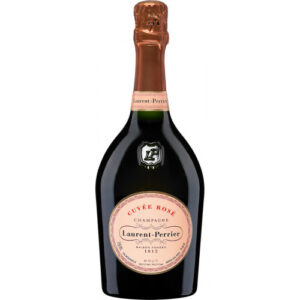
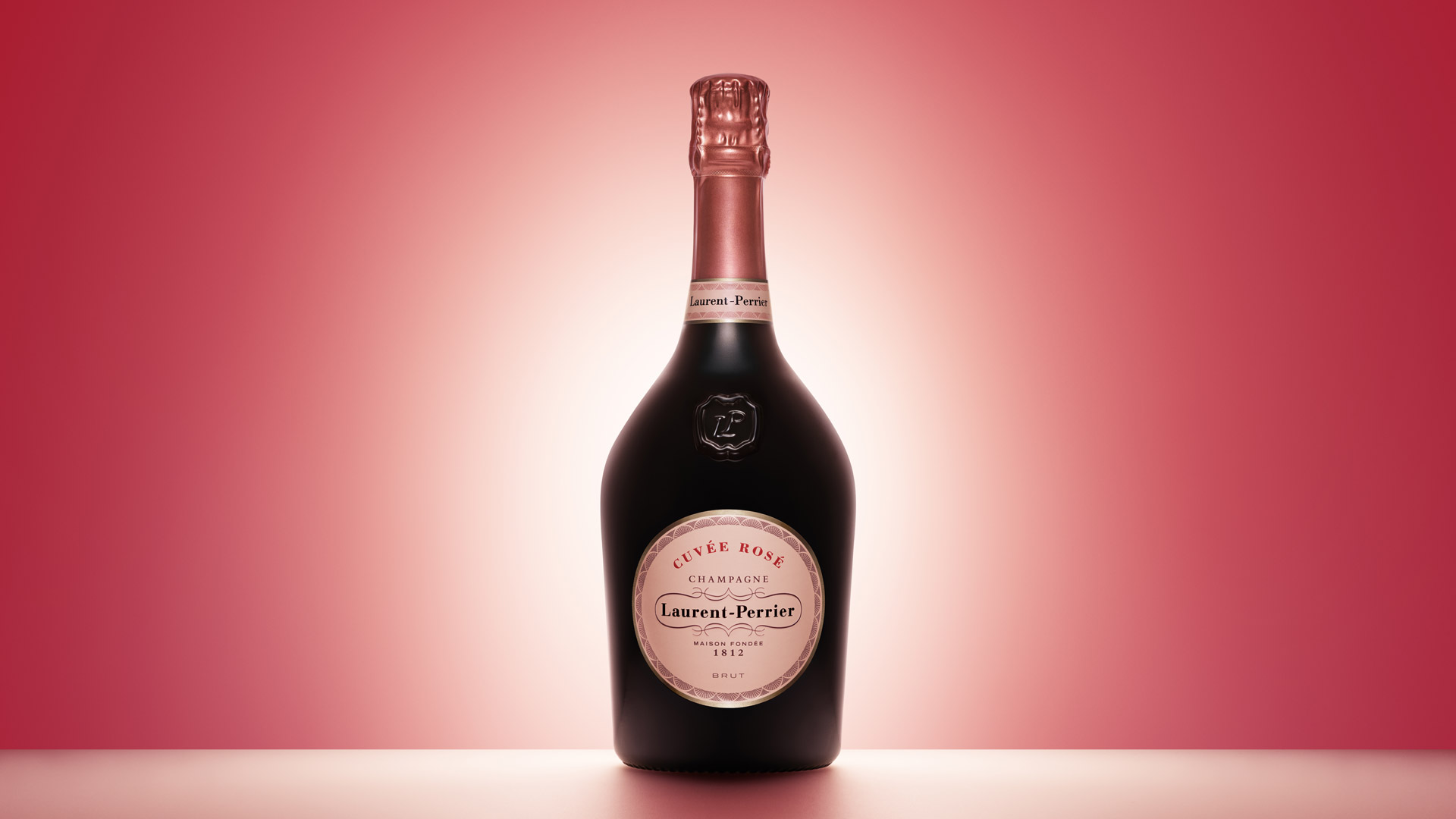
- The bottle shape of the Cuvée Rosé is distinctive: inspired by 17th-century “Henri IV” style stubby bottles, with a monogrammed “LP” shield, making it recognisable and premium in presentation. (The Finest Bubble)
- Colour: The house describes the robe as evolving from “a pretty raspberry hue to salmon pink”. (millesima.fr)
Style Intentions
The intention behind this cuvée is to deliver a rosé Champagne with bold red-fruit character, freshness, and structure—rather than a light blush fizz. The focus on 100% Pinot Noir and maceration ensures richer fruit extraction than many rosé Champagnes which simply blend still red wine or add a small proportion of Pinot Noir. The house’s language: “intense and fresh”, “richest and most subtle expression of Pinot Noir”. (Laurent-Perrier)
3. Tasting Profile & Characteristics
Here is what you can expect when you open a bottle of Laurent-Perrier Cuvée Rosé Brut.
Appearance (Visual)
- Colour: light salmon-pink, sometimes with copper or salmon rose reflections. Example description: “medium salmon pink, subtle copper reflections”. (falstaff.com)
- Mousse: fine, persistent bubbles giving a delicate and lively effervescence. (premierchampagne.com)
Aroma (Nose)
- Primary aromatics: a clear red-fruits bouquet — raspberries, strawberries, redcurrants, black cherry. According to the house: “a wide range of red fruits: raspberry, redcurrant, strawberry and black cherry.” (Laurent-Perrier)
- Secondary notes: some sources mention hints of baked goods, brioche, almond, roasted cashew, subtle spice. For example: “radiant nose of ripe red berries … spiced biscotti and roasted cashew” in one review. (wine.com)
- Freshness and minerality: The nose often presents freshness and a vivid red-fruit character combined with subtle mineral or chalky underpinning. For instance: “ripe cherry fruit underlay with lemon balm, subtle hints of wild berries … delicate notes of baked goods and orange confit” (from Falstaff review). (falstaff.com)
Palate (Taste & Texture)
- Entry: crisp and fresh, with an acid lift that gives vibrancy. The house describes “a fresh and sharp attack” then “a supple and rounded wine”. (millesima.fr)
- Mid-palate: rich red fruits dominate: raspberry, strawberry, cherry, redcurrant. The texture is smooth yet has structure due to the Pinot Noir backbone and the maceration extraction. One note: “broad palate … raspberry and black cherry … long, almost voluptuous finish” for example. (wine.com)
- Finish: long, elegant, with fine minerality and persistent red fruit flavours. According to reviews: “fine minerality with a full-bodied texture … good persistence … versatile”. (falstaff.com)
Overall Impression
The Cuvée Rosé Brut is both expressive and refined: it delivers bold red-fruit character and colour, yet remains clean, balanced and elegant. It is less about the heavy bread/brioche tertiary notes of heavily aged Champagnes and more about fruit purity with finesse. On community forums some drinkers highlight:
“Light salmon in color with a peachy hue. Nose of over-ripened apples, citrus, light red fruits, spices, minerals, yeast and brioche.” (Reddit)
Another:
“The first thing that hit my nose was notes of strawberries and bright red cherries. On the palate, … lovely creamy mouthfeel … hint of grapefruit toward the end.” (Reddit)
Thus we see real-world drinking impressions align well with the technical descriptors.
4. Serving Recommendations, Food Pairings & Storage
Serving Temperature & Glassware
- Serve chilled: recommended temperature ~8-10 °C. Many sources suggest 8-10 °C to allow aromas and bubbles to shine. (millesima.fr)
- Use a tulip-shaped Champagne glass or a flute with good volume to allow bubbles and aroma release.
- Opening: chill the bottle thoroughly, open gently, pour carefully to preserve fine mousse.
Food Pairings
The vibrant red-fruit core and freshness of the Cuvée Rosé make it very versatile. Suggested pairings include:
- Aperitif: Its vibrant fruit and elegance make it ideal as a pre-meal drink. For example: “fresh raspberries, strawberries … great as aperitif”. (laithwaites.co.uk)
- Seafood & Shellfish: Marinated fish, sushi, sashimi, prawns, lobster with light sauces. The freshness cuts through and complements delicately flavoured fish.
- White Meat & Poultry: Grilled chicken, duck breast, or light poultry dishes with fruit compotes or red-berry sauces.
- Cheeses & Charcuterie: Light cheeses, perhaps goat or young soft cheeses; Parma ham is mentioned by the house site as an ideal pairing. (Laurent-Perrier)
- Dessert & Fruit: Red fruit desserts (raspberry tart, strawberry mousse) or fresh fruit platters work wonderfully. The house specifically suggests “desserts aux fruits rouges”. (Laurent-Perrier)
- Ethnic Cuisine: Because of the fresh fruit and acidity, dishes with subtle spice (Thai, Asian, lightly spiced cuisine) can pair surprisingly well. (millesima.fr)
Storage & Ageing Potential
- Because Cuvée Rosé is a non-vintage expression crafted for both immediate enjoyment and some evolution, it is drinkable upon release and for a number of years after, but is not primarily designed for very long cellar ageing (like vintage prestige cuvées).
- That said, many sources note a potential cellaring window of 5-8 years or more if stored properly. For example: one site notes “Drink: Now for 8+ years”. (The Finest Bubble)
- Storage conditions: Keep bottle horizontal (or at least away from light and vibration), in a cool, stable environment (~10-13 °C), ideally with moderate humidity, and remove from light/heat before serving.
- As the focus is on fruit freshness, prolonged ageing may soften the initial vibrant red-fruit character and shift into more tertiary notes; so if your preference is pristine fruit, drink earlier.
5. Market Positioning, Pricing & Availability
Positioning
- Cuvée Rosé Brut is one of the flagship rosé Champagnes of Laurent-Perrier and is widely recognised as a benchmark in its category. It blends heritage (the house’s innovation in rosé) with approachable luxury.
- Because it utilises 100% Pinot Noir and maceration, it sets itself apart from many rosé Champagnes that either blend red wines or use a lower proportion of Pinot Noir.
- In terms of prestige and price, it sits above entry-level Champagnes but below the ultra-luxury, limited-edition prestige cuvées. It is often seen as a “serious rosé” in the non-vintage arena.
Pricing
- Retail pricing varies significantly by country, import duties, taxes, packaging and vintage/disgorgement details. In many European markets the standard non-vintage Cuvée Rosé Brut is seen in the ballpark of €60–90 (for the 750 ml bottle) depending on location. For example one site lists about £62.99 in the UK. (Reddit)
- One online listing cites ~$95 (USD) for the bottle in a US-based retail site. (premierchampagne.com)
- For emerging or high-duty markets (e.g., Africa, Asia), the final retail price may be much higher after import duties, taxes, and mark-up.
- Auction/average resale references: For Cuvée Rosé Brut NV 2010s, an average bottle price is listed around €60 in one chart. (tastingbook.com)
Availability
- Because Laurent-Perrier is a major house, the Cuvée Rosé is widely distributed globally, though specific vintages, large formats (e.g., magnum), or special editions may be limited.
- For buyers in places such as Douala (Cameroon), you’ll want to verify authenticity (since prestige Champagnes attract counterfeits) and check storage conditions before purchase (especially if imported or shipped).
- Consider importing or acquiring from authorised local distributors to avoid issues of provenance or condition.
6. “People Also Ask” – Common Questions & Answers
Below are many of the questions people search for regarding Laurent-Perrier Cuvée Rosé Brut, along with answers based on credible sources.
Q: What grapes are used in Laurent-Perrier Cuvée Rosé Brut?
A: It is made from 100% Pinot Noir grapes. (Laurent-Perrier)
The grapes are drawn from about 10 different crus, mainly in the Montagne de Reims region (including Ambonnay, Bouzy, Louvois, Tours-sur-Marne). (The Finest Bubble)
Q: How is it made / what is the production process?
A: The key distinctive feature is the maceration (saignée) method: after destemming, the must is macerated on the skins for 48-72 hours, allowing extraction of colour and aromatic compounds from the Pinot Noir skins. Then the juice is pressed, fermented and aged (typically around 5 years on lees for non-vintage). (Laurent-Perrier)
This contrasts with rosé Champagnes made by blending still red wine or small addition of red wine: Laurent-Perrier emphasises extraction via maceration to give direct expression of skin contact. (The Finest Bubble)
Q: What is the dosage and alcohol content?
A: The dosage is approximately 8 g/L for many bottlings, though some sources mention 9 g/L. (lambierwines.com)
Alcohol content is approximately 12% vol. (falstaff.com)
Q: What does it taste like? What are the tasting notes?
A: Tasting notes frequently include:
- Appearance: salmon-pink or raspberry hue with fine bubbles. (millesima.fr)
- Nose: fresh and intense red fruit (raspberry, strawberry, redcurrant, cherry), sometimes black cherry, wild berries; subtle notes of almond, roasted cashew, biscuit or brioche appear in certain reviews. (wine.com)
- Palate: Crisp entry, smooth mid-palate rich in red-berry fruit, elegant minerality, good structure from the Pinot Noir; finish is long and refined. For example: “juicy, elegant, fine minerality … red berries and good persistence”. (falstaff.com)
Therefore, expect a rosé Champagne with more depth and structure than many lighter rosés, and with serious fruit character.
Q: How should it be served and what food pairs well?
A: Serve chilled at around 8-10 °C to best appreciate the fruit and bubbles. (millesima.fr)
Food pairings:
- Aperitif: Works beautifully by itself.
- Seafood & shellfish: Marinated fish, sashimi, prawns, lobster.
- White meat/poultry: Grilled chicken, duck with fruit sauce.
- Cheeses/charcuterie: Young cheeses, cured ham (like Parma ham). (Laurent-Perrier)
- Desserts & fruit: Red-fruit desserts (raspberries, strawberries) or fresh fruit presentations. (Laurent-Perrier)
- Ethnic/spicy cuisine: Because of its freshness and fruit, it can pair well with lightly spiced Asian or exotic dishes. (millesima.fr)
Q: How long can you cellar Laurent-Perrier Cuvée Rosé Brut?
A: As a non-vintage Champagne crafted for style and enjoyment, the ideal window is to drink now or within the next few years. Some sources note a potential ageing window of 5-8 years or more, provided excellent storage. (The Finest Bubble)
As with any Champagne, proper storage is key (cool, dark, stable environment). While ageing further may bring tertiary notes (brioche, toast), many fans of this cuvée appreciate its youthful red-fruit character, so waiting too long may shift the profile away from what the house emphasises.
Q: Is Laurent-Perrier Cuvée Rosé Brut a good value?
A: Many reviewers and drinkers believe so. For example, community tasting notes say:
“This is the best non-vintage rosé Champagne by far! … $75 is a great price for it.” (Reddit)
Ratings are strong: 93 points (Falstaff) for recent non-vintage. (falstaff.com)
Given the pedigree, 100% Pinot Noir, extended lees ageing and strong taste profile, for many the price is justified. That said, value is relative to local market pricing and currency/ import mark-ups.
Q: What distinguishes this rosé Champagne from others?
A: Key distinguishing points:
- Use of 100% Pinot Noir and serious maceration rather than simple blending of red wine.
- A high-quality sourcing of grapes from 10 crus including top Pinot Noir villages.
- Extended aging on lees (5 years typical).
- The house’s innovation and heritage in rosé Champagne production (since 1968).
- A bottle design that is distinctive and premium.
These give Cuvée Rosé a structure and depth that many entry rosé Champagnes lack.
Q: What is the colour like and does bottle appearance matter?
A: Colour is described as “elegant, from raspberry hue to salmon pink” for the robe. (millesima.fr)
Colour is part of the appeal, and the distinctive bottle design (monogrammed LP, shaped body) adds to the visual-luxury cue. According to some drinkers, the pink tone and bottle design enhance the experience. (Reddit)
7. Pros & Cons – What to Consider
Pros
- Premium quality: With 100 % Pinot Noir and careful maceration and ageing, it offers more depth than many rosé Champagnes at the non-vintage level.
- Strong taste profile: Vibrant red fruits, refined mousse, good structure and finesse.
- Versatility: Works both as an aperitif and through a meal, and pairs with a variety of foods from seafood to light desserts.
- Prestige & recognition: Well-rated by critics (e.g., 93 pts Falstaff) and widely respected. (falstaff.com)
- Presentation: Attractive bottle, distinct colour, adds a touch of celebration and style.
Cons / Things to Consider
- Price: Being premium, it costs more than “entry-level” Champagnes; value depends heavily on local pricing and import mark-up.
- Non-vintage: While quality is high, it is not a vintage Champagne or prestige cuvée, so if you’re seeking a major-cellar investment the expectation should be tempered.
- Style preference: The fruit-forward red-berry profile and maceration style might be less preferred by drinkers who favour ultra-lean Chardonnay-driven blanc de blancs or highly toasty/brioched aged Champagnes.
- Storage importance: Because it is premium, if the bottle has been poorly stored (heat/light exposure) the value and enjoyment drop significantly; verifying provenance is wise.
- Cost-benefit in certain markets: In high-duty import markets the final retail price may knock it out of “good value” territory.
8. Conclusion
In conclusion, Laurent-Perrier’s Cuvée Rosé Brut is an excellent choice for anyone seeking a high-quality rosé Champagne that offers depth, elegance and distinctive character. It stands out for its 100% Pinot Noir identity, the maceration technique, the firm sourcing of top vineyards and the house’s reputation. For those in Douala (Cameroon) or elsewhere looking for a celebratory bottle, this Champagne ticks many boxes: it impresses visually, tastes refined, has strong pedigree, and pairs well across a range of foods.
When to pick it:
- For a special occasion (anniversary, celebration, gift) where you want something a little more remarkable than a standard Brut.
- When you’re pairing with dishes that complement red-berry fruit, freshness and elegance (seafood, poultry, charcuterie, dessert).
- If you appreciate rosé Champagne and want something premium rather than entry level.
When you might choose differently:
- If your budget is constrained and you need the most cost-effective bubbly, there may be good value elsewhere.
- If you prefer vintage Champagnes or prestige cuvées with longer ageing and highly tertiary characteristics.
- If you prefer the ultra-lean, ultra-Chardonnay (blanc de blancs) style of Champagne rather than Pinot Noir-driven rosé.
Final verdict: Yes — Laurent Perrier Cuvée Rosé Brut is a smart buy, provided you find it at a fair price and the bottle has good provenance. It delivers tangible premium attributes and drinking pleasure. I would recommend securing one and enjoying it with good company or food. Keep the bottle chilled and enjoy the vivid fruit expression and finesse it offers.

Jack Daniel's Old No. 7 Tennessee Whiskey
The Sassenach Blended Scotch Whisky 


Reviews
There are no reviews yet.